

Dynamic Data Driven Simulation for Wildfire Spread Prediction
What is Dynamic Data Driven Simulation?
The dynamic data driven simulation represents a new simulation paradigm where a simulation system is continually influenced by the real time data streams for better analysis and prediction of a system under study. Early concepts of dynamic data driven simulation was supported by NSFs DDDAS "Dynamic Data-Driven Application System" program. See NSF DDDAS website, and a Wikipedia entry for DDDAS.
Why Is Dynamic Data Driven Simulation Needed in Wildfire Simulation?
Computer simulations have long been used for studying and predicting wildfire spread. The accuracy of these simulations depends on many factors, including the GIS data, fuel data, weather data, and high fidelity wildfire behavior models. Due to the dynamic and stochastic nature of wildfire, it is impossible to obtain all these data with no error. For example, the weather data used in simulation is typically obtained from local weather stations in a time-based manner (e.g., every 10 minutes). Before the next data arrives, the weather is considered unchanged in the simulation model. This is different from the reality where the real weather constantly changes (e.g., due to the interactions between wildfires and the weather). Besides data errors, the wildfire behavior model also introduces errors because of its computational abstraction. Due to these errors, the predictions from the simulation model will almost certainly be different from what is in a real wildfire. Without dynamically adjusting the simulation model, the difference between the simulation and the real wildfire will continuously grow.
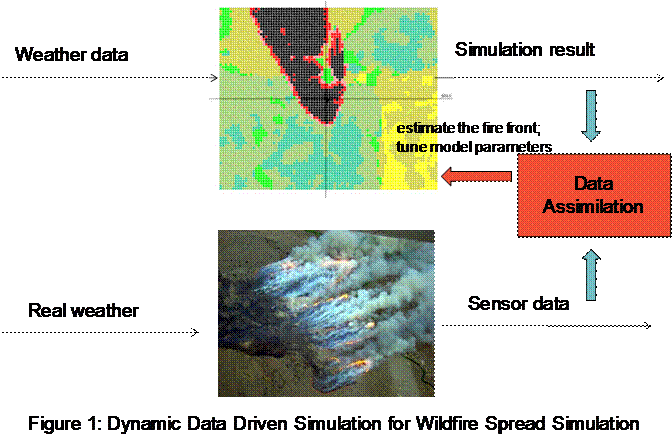
The goal of dynamic data driven simulation is to establish a feedback connection from a real wildfire to the simulation model by utilizing the real time data collected from the wildfire. By assimilating these data from the real wildfire, the simulation system continuously adjusts itself, e.g., to estimate the continuously evolving fire front and to tune the model parameters, in order to achieve more accurate predictions of wildfire spread. Figure 1 illustrates this idea.
How Does the Dynamic Data Driven Simulation Work - An Illustrative Example
The following example illustrates how the dynamic data driven simulation works in a wildfire spread simulation. In this example, a simulation is first run to represent the “true” wildfire. The observation data obtained from this simulation are regarded as coming from the “real system". By assimilating these observation data, we intend to show that the wildfire simulation is able to track the “true” fire front and thus gives more accurate fire spread predictions even it uses inaccurate weather data. The data assimilation method used in this example is based on Sequential Monte Carlo Methods (also called Particle Filters).
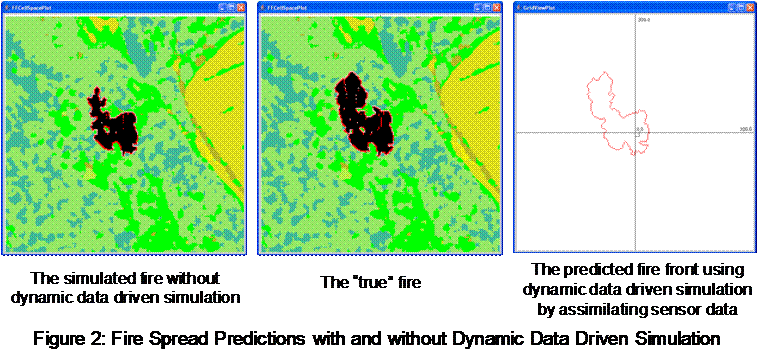
In this experiment, the "true" wildfire uses the "real" weather data, which are randomly generated within a range: wind direction is 180±50 degrees and the wind speed is 8±4 miles/hour. This "real" weather data is unknown to the simulation, which uses unchanged weather data: wind direction is 180 degrees and the wind speed is 8 miles/h. Due to this weather difference, the "true" fire and the simulated fire are different. This is shown by the left and central diagrams in Figure 2.
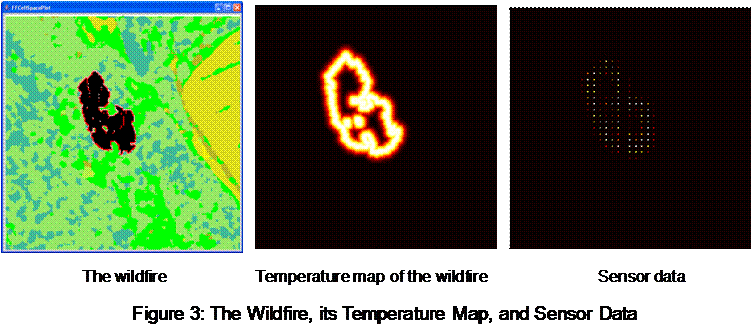
Although we do not have the accurate weather data, we do have some observation data from the "true" wildfire. In this example, we assume the observation data comes from ground temperature sensors that are regularly deployed in the fire area. Figure 3 shows the "true" fire, its temperature map, and the temperature sensor data obtained from the temperature sensors. In the temperature diagrams, different degrees of temperature are shown in different colors.
By assimilating the above sensor data, the dynamic data driven simulation was able to track the "true" fire's evolving fire front and thus gave more accurate predictions of wildfire spread. This is shown by the right diagram in Figure 2 (not Figure 3). From this Figure, one can compare the wildfire predictions with and without dynamic data driven simulation to see the merit of dynamic data driven simulation.
Questions and comments? Please contact Dr. Xiaolin Hu at xhu@cs.gsu.edu, webpage: http://www.cs.gsu.edu/xhu/.
This material is based upon work supported by the National Science Foundation under Grant No. 0841170. Any opinions, findings, and conclusions or recommendations expressed in this material are those of the author(s) and do not necessarily reflect the views of the National Science Foundation.